

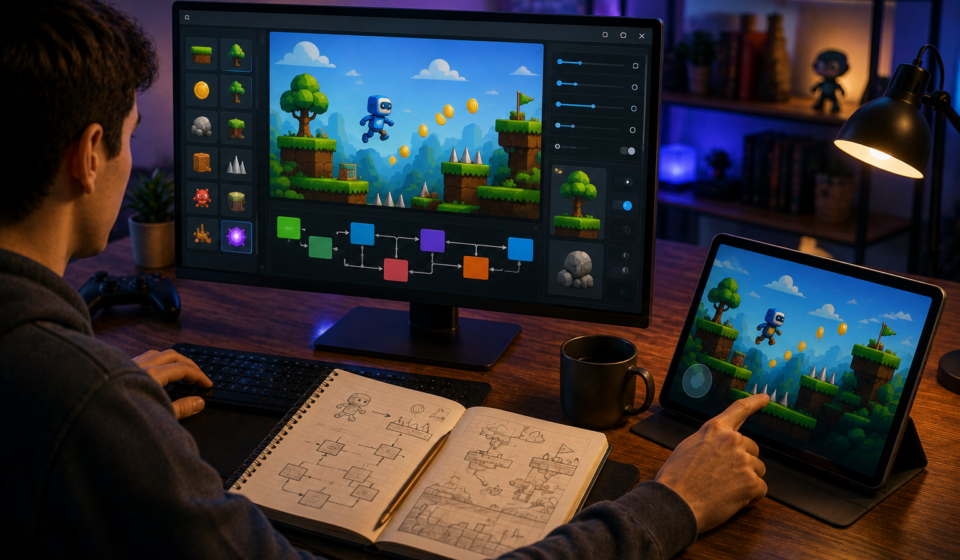

Interactive games have always demanded more than static content, they need to respond, adapt, and react to what a player actually does. That responsiveness used to require real coding skill to implement, regardless of how good the underlying idea was. It doesn’t anymore. Building genuinely interactive games without touching code is now a complete, achievable process, not a simplified workaround.
What Makes a Game Genuinely Interactive
Response, Not Just Rules
A game becomes interactive when player actions produce clear, meaningful consequences, not just when it technically has rules attached to it. A game with branching paths that all lead to functionally identical outcomes isn’t really interactive, regardless of how the underlying logic is structured.
Feedback That Feels Connected to Action
Genuine interactivity depends on players feeling a clear link between what they did and what happened as a result. That connection is what separates a game that feels alive from one that just technically responds to input.
Getting Clear on Your Interactive Concept First
Define the Core Decision or Action
Before generating anything, know exactly what the player does that should feel meaningful, dodging, choosing, timing, building. A game like Tiny Planet Chopper works because its core interaction, navigating and reacting in real time, is immediately clear and consistently responsive. That clarity should exist in your own concept before you start building.
Know What Consequence Should Follow Each Action
Interactive design depends on understanding not just what the player does, but what should visibly happen as a result. Success and failure both need clear, felt consequences for an interaction to feel genuinely meaningful rather than arbitrary.
Building Your Interactive Game Step by Step
Step 1: Describe the Interaction in Plain Language
Explain exactly what happens when the player acts, what triggers a response, what that response looks or feels like, and what happens when they succeed or fail. Make your own game platforms translate that description into a working, responsive system without requiring any code from you.
Step 2: Play the Rough Version and Focus on the Response
When you first play your generated version, pay close attention to how it responds to your actions specifically. Does the feedback feel immediate? Does it feel connected to what you actually did? This is where you evaluate whether the interaction is genuinely working, not just technically functioning.
Step 3: Identify Where the Interaction Feels Disconnected
If a response feels delayed, unclear, or doesn’t match what you expected, that’s specific, useful information. Note exactly where the disconnect happens rather than dismissing the whole version as not working.
Step 4: Adjust One Element of the Interaction at a Time
Change the timing, the visual feedback, or the specific consequence of an action, one element at a time, and test again. This isolates what’s actually improving the feel of the interaction from what’s just different.
Step 5: Get Someone Else to Interact With It
Watch someone unfamiliar with your project actually play and react. Their genuine responses, hesitation, confusion, excitement, reveal whether the interactivity is landing the way you intended, something you can’t fully judge from the inside.
Step 6: Layer In Additional Interactive Depth Gradually
Once your core interaction feels genuinely responsive and satisfying, consider adding secondary systems. Building additional interactivity on top of a solid, well-tuned foundation tends to deepen the experience rather than making it feel scattered.
Common Mistakes When Building Interactive Games This Way
Describing the Setting Instead of the Interaction
A description focused on story or atmosphere without specifying how the player actually interacts tends to produce a vaguer, less responsive first version. Be specific about the action and its consequence, not just the surrounding concept.
Adding Too Many Interactive Systems Too Early
It’s tempting to build several interactive elements at once. Confirm one interaction feels genuinely good before layering in more, otherwise it becomes difficult to tell which system is responsible for any given problem.
Assuming Technically Functional Means Genuinely Interactive
A generated version might technically respond to input without actually feeling meaningful or satisfying. Don’t mistake basic functionality for the deeper sense of responsiveness that makes interactivity genuinely engaging.
Skipping Real Player Testing
Interactive systems are especially hard to judge from the inside, since you already know what response to expect. Outside testing matters more for interactive games specifically than for many other types of mechanics.
Why This Approach Works Well for Interactive Games Specifically
Fast Iteration Matters More When Feel Is Everything
Interactive systems are difficult to evaluate on paper, their quality depends entirely on how they feel in actual play. Being able to describe, generate, test, and adjust quickly is especially valuable here, since the only reliable way to know if an interaction works is to experience it directly.
Comparing Different Response Styles Becomes Realistic
Because generating a variation costs little time, you can test different ways of handling the same interaction, faster versus slower feedback, forgiving versus strict timing, and directly compare which one actually feels better to play.
A Practical Checklist for Building Interactive Games
- Define the core action and its intended consequence clearly.
- Describe the interaction specifically, not just the surrounding concept.
- Play the rough version focusing entirely on how it responds.
- Adjust one element of the interaction at a time.
- Get outside players to react to it before adding more depth.
- Layer in additional systems only once the core interaction feels solid.
Final Thoughts
Building interactive games without learning to code is entirely achievable now, but genuine interactivity still depends on the same fundamentals it always has: clear actions, meaningful consequences, and feedback that feels connected to what the player actually did. The technical barrier that used to stand between an interactive idea and a working version of it has been removed. What still determines whether that interactivity actually feels good remains entirely a matter of careful design and honest playtesting.
Start with one clear, well-defined interaction, feel how it responds, and refine based on that feeling before adding anything more. That process, more than any specific tool, is what turns a static idea into something people genuinely want to interact with.